. . . and No Stewardship Campaign

Instead of helping with a stewardship campaign today I got to go on a special wine tour with some wonderful friends. Doug and Linda Cruikshank had bid on this special tour at some charity event. They could take four friends, so we got to tag along with Bill and Jane Moore. The winery was Trisaetum (rhymes with I ATE 'em). Our tour was lead by Andrea Fry who with her husband, James owns this beautiful estate. Actually they own two estates. The winery building is located just outside of Newburg, and the other estate is just outside of McMinnville.
They are still processing fruit. Andrea explained that they were going to let the Riesling hang even a bit longer, but when James went out to check on the fruit and grabbed one of the clusters all of the grapes fell off. James appeared at one point in the tour looking a bit haggard. Turns out he hasn't have a day off in 42 days. (They are hoping to have Thanksgiving Day off!) James has some almost finished Sauvignon Blanc that we get to taste (poured from a beaker which I just think is so cool.) I am impressed with the production facility. It is exactly what you would do if you had the resources to make it happen. They have a number of large wood fermenters which are located up on a ledge so that they do not need to be pumped out, but can be fed by gravity instead. I'm thinking that's pretty cool when Andrea shows us the secret tube that goes through the wall and down the floor into the barrel cave! So, when they are putting the wine into the barrels, they just feed the hose downstairs and let it flow into the barrels. Once a year they do a club member's dinner in the cave. It is a very cool space. Andrea does a wonderful job of talking us through the production while at the same time moving us through their selection of wines. Three of the wines are from their Artists series. It turns out they have an artist on sight who makes a custom painting for each of the releases. And it's handy that he also happens to be the winemaker and owner. Really, that is just too much talent to be located all in one person. He can also figure out computer programs which just doesn't seem fair. There is a gallery of Jame's work just off of the regular tasting room. Many of the pieces of art include debris from the vineyard. Some have vines incorporated into them while others have grape seeds and some of the dirt from the vineyard. There is just something so right about art combined with wine. The fact that the same artist at Trisaetum makes both is even more fun. That and the barrel cave gives this winery a very unique and beautiful aesthetic.
After our tasting we decide to stop for lunch at Farm to Fork in Dundee. It was wonderful. And the conversation was wonderful. And the wine was wonderful. And the fact that a very successful stewardship campaign took place this morning at McMinnville Cooperative Ministries without me? Priceless!

Weekend of Wine and Women

I was able to get back up to Coeur de Terre Winery today, and this time I wasn't working, I was enjoying the beautiful wines. For the last two weekends the winery has been doing a special vertical tasting of their estate Pinot Noir. It is so interesting to me to see how much of a difference you can taste in the wines from year to year. The basic backbone of the place is present in each, but they are also quite different. And they are holding up beautifully. Scott and Lisa only stated making an estate blend in 2005. Up until that point all of the wine came from
one block. '05 was wonderful and is ready to drink right now. The '06 tastes to me like it will continue to get better and better. '07 is so different--so full of an earthy, musky type of aroma and I love it.
We had the pleasure of sitting and talking with Lisa Neal who with her husband, Scott, owns Coeur de Terre. We get her talking about the very beginning of the winery. "We had to go slowly because we didn't have much money, and I think that was really good" she said. That time allowed them to explore their property, find out where the cold spots were, where the soil drained well, and where it didn't, and just gave them a better feel of where vines would thrive. Figuring out the soil took some detective work. There are several different soil types in their small estate. Just Abby's Block alone has four or five different types of soil all by itself.
They also couldn't afford to purchase grape vines that were already grafted, so they decided to do the work themselves. It cost them $1 per plant to do it themselves, and it cost $3.50 per plant to get them already grafted. Scott signed up for an internet class on grafting and proceeded to purchase every book he could find on the subject. They also found some budding vineyard owners and sought out their help. It was funny because Karlene (Jeff's mother) was asking me on the way up how wine makers learn their craft. I shared with her that some go to school, and then work in a winery. Others hang out with other winemakers and watch what they do (kind of like I did this year.) Quite a few start making wine in their basement and decide to make the leap to larger production.
Some experienced vineyard owners told Lisa and Scott not to do their own grafting--that it would never work. This acted as a catalysis for Scott and made him determined to do it himself.
I look out into the production side of the winery and it is jam-packed with barrels. I'm not sure how many more they could get in there. They are still out in the warm side of the production facility because they are finishing up their ML fermentation. I also get a chance to walk around the vineyard a bit. There are so many birds, more than when the fruit was still on the vines. It is so nice to sit and listen to them--without having a propane cannon go off next to your head. Lisa says that at some point she'd like to try and do some self-rooted plants in the vineyard. She explains that the grafted vines will only live for about 35-40 years. Self rooted vines will produce fruit for over a hundred years--IF they don't get infected with the phylloxera root louse. It is interesting to me that I may live to see many vineyards of Oregon replanted eventually.
Friday night at Wednesday Wines we had a little retirement party for my walking partner, Irma Karns (she's retiring from her insurance job, not from being my walking partner.) It was a wonderful way to celebrate a life of service and integrity. We're also going to a special wine tasting and luncheon tomorrow with some good friends. I love to enjoy beautiful wines with people that I love. Sharing a glass of wine can add so much to an already wonderful celebration. We'll be celebrating a great deal this next year. I celebrate that I'm going to be able to see my worshiping community again next week. Then my son's wedding takes place in January, and my daughter's in August. That's a lot to celebrate. And so is a day spent with friends enjoying half a decade of estate wines. On the way out to the car Judy shares that this is one of her favorite wineries, both the wines and the place. I couldn't agree more.

ML Inoculation at Coeur de Terre

Yes, it's true, we've given our little baby Pinot Noir barrels their inoculation. Malolactic fermentation is used to help convert some of the more tart tasting malaic acid into a smoother, rounder lactic acid. This is accomplished by adding a bacteria culture. It's kind of strange that
we've done everything heavenly possible to prevent bacteria from getting into the wine. We carefully cleaned everything that would touch the juice (several times.) We put a blanket of Co2 on the top of the cold soaking grapes to keep bacteria out. We cleaned and steamed each barrel. And, now, after fermentation is complete, we're adding a bacteria into the wine.
I think the exact bacteria is Oenococcus oeni. Scott showed me the container, and I looked it up on line, and I think this is the one. One way to have the wine go through this process would be to just bring it up to a temperature of 70 degrees or so and let it go. The bacteria are probably present in the wine already, but Scott doesn't like to leave things to chance, so, we inoculate.
In the photo to the left, Ryan is stirring the wine in the barrel with one hand, while pouring in the solution with the other. Scott has combined some water and food with the brown powder and shown us the amount to go in each barrel. Ryan and I get into a groove where he pours the solution into the barrel, and I clean up, and put a chalk check mark on each barrel to show that it is complete. Every once in a while we stop and smell the wine in the barrels. It is so beautiful now. Especially the estate wines in the new oak barrels present themselves well.
After we are finished with the inoculation I decide to take a walk around the property. It is interesting that the leaves are falling off the vines from the bottom of the hill up to the top of the hill.
The grapes at the bottom of the hill mature earlier, and you can kind of see the progress in the photo to the left. No leaves at the lower section of the hill, and still some bright colored leaves at the top. Part of the reason that the leaves still have color at the top of the vineyard is that they were not as affected by the cold weather that we had a couple of weeks ago. The cooler air flowed down towards the valley floor and left warmer air up above.
Scott is getting ready to attend a conference for his other work, so I'm kind of wrapping things up. I hope to be around for the harvest of the Riesling vines from Highland Vineyards, but I maybe back in the pulpit by then. I head back in less than two weeks now, so it's going to be close. I never would have predicted that when I was planning out my sabbatical in June. This is by far the latest harvest they have ever had in the Willamette Valley. On Saturday I get to go back up to Coeur de Terre to taste some wine for a change. That's still my favorite part of the wine making process--consumption. I'm glad there are others who enjoy making it for us. I'll appreciate what they do a lot more now. One very strange aspect of this experience is the overwhelming sense that I know less now than when I started. The first step in learning anything is to go from unconscious incompetence to conscious incompetence. And I guess that's where I am. I now know how much I don't know about wine. And that just makes me want to learn more. And, the best way to do that it to do research. So wine tasting here we come!

This One Goes on Eleven

I had an almost surreal feeling today at Coeur de Terre. Maybe it's the numerology of the day (11-11-11), or maybe it's the sudden change in weather with a pretty steady stream of rain on the horizon. Suddenly I am pretty much done with my internship in the vineyard and it just feels so strange. I've kind of centered my life on the place for the past two to three weeks, and now it's pretty much over, and somehow I just didn't see it coming.
I went up today to prepare lunch for the crew. It was a joyous occasion with most of the regular work crew, a couple of other guys who are working on the house and all of the Neal clan. Lisa asks me if that's OK. I tell her that I have portion control issues, and that I could probably feed twice that many people, and that turns out to be about the case.
Ryan uncharacteristically decides to crack open an '05 Estate Pinot Noir for lunch. It is bright and beautiful, and is showing beautifully what good wine will do in the bottle. The flavors are getting more and more complex. But, I believe, it's not even close to being as good as it will get. Scott chooses to make wines that taste good right away, but will age wonderfully, and this '05 is
a great example. Scott decides we should taste the '06, '07, and '08 as well. Oh my. Each vintage has a common aroma and flavor component, but they are so different from one another. Kind of like children. By the way, Coeur de Terre is pouring a special vertical tasting the next two Saturdays for club members. I would suggest you go up and join one of the clubs and have a taste.
After lunch Scott, Abby, Talulah and I grab a basketball and shoot some hoops. Lisa comes down to join us. She shoots two or three shots with her right hand and then just switches up and goes with the left without skipping a beat.
Berto is cleaning out the last of the barrels. There is a special sprinkler that gets hooked up to the steam cleaner and left to run inside the barrel for ten minutes or so. It's the last step in cleaning the barrels before the wine will be added to them.
I glance into the winery. It is so full of barrels. That's a lot of wine we're making. There is a dense blanket of warm, yeasty, moist air that enfolds you as you enter the room. My camera lens fogs up right away, but the light effect with the windows is really cool, so I keep the shot.
I also went for a walk around the vineyard after lunch. The leaves are mostly gone and the vines stand as lonely sentinels on the hilly slopes. A few strangling grapes are still in place but mostly it is empty and quiet. There are no more beautiful clouds and sunny skies. It is, and will continue to be, overcast. The photos I find now are more still life, and less scenic. The vineyard is telling me that the season for grapes is over. The harvest is in, and it's time to move on.
I'll be going back up to the vineyard next week just to check in, and I've told Ryan that I'll run the cash register Friday and Saturday of Thanksgiving weekend. I haven't gotten a chance to experience the retail side of the winery, and, heck, I might as well just jump in right on some of the busiest days of the year.
I know I've said it before, but I just can't believe how blessed I am to have gotten this experience. I'm so thankful to Scott and Lisa Neal the owners of Coeur de Terre for allowing me to get my feet wet making wine (quite literally on many days.) I'm thankful to Ryan for answering a myriad of questions about the industry and about hospitality. I'm thankful to the crew of workers at Coeur de Terre and their patience with me and my inability to do many of the tasks that they seem to do so easily.
At the end of the day my good friend, Jeff Peterson, comes up. He has a great discussion with Scott and Lisa while I loose a game of horse to Abby (but I beat her at around the world.) Then Jeff and I go up to taste some wines. Ryan makes the mistake of saying he thinks it would be great to have an intern at the winery. Jeff is not the guy you want to say that to, if you don't want to have a detailed discussion about it for half an hour or so.
Jeff enjoys some of the corn bread I made for lunch, we enjoy some wonderful wines, and then it's time to head home. I'm ready, I miss my community at McMinnville Cooperative Ministries. I've missed the wonderful people like Jeff and Courtney. But I'm so glad I got a chance to do this. Truly, this experience goes to eleven.

The Fibonacci Winery Building

As I'm wrapping up my internship at Coeur de Terre it occurs to me that I've never talked to Scott about the design of the winery building itself. I love the building, and have very much enjoyed visiting, and sipping wine in the tasting room upstairs. Now, however, I realize how well laid out the working sections of the building are, and especially how smoothly the works flows. So I ask Scott about it. "Well, of course I based it all on the Fibonacci sequence." And once again, I'm starring at Scott like a cow starring at a new gate. You could say that Scott is a numbers guy.
It turns out I do know the principle. I know it from photography. For example that little guy to the right is sitting in the right hand side of the rectangle that is left over when you form a box of the other part of the frame. In other words, photos don't look good when the subject is dead center. The fact that the bird is looking towards the largest part of the frame is even better. At some level I just know this, my mind kind of sub consciously senses it when I'm framing a photo. It helps though, to think about it consciously from time to time. And Scott does. The tasting room is like that photo. If you look at the building layout, it is the smaller section of a large triangle that is left over from the square of the wine making area.
I ask Scott if he based his winery on another that he'd seen. I also want to know how he figured out all of the mechanical systems, and the flow of the work area. It's just not something that you think a lot about when you are enjoying a glass of wine, but when you're in the winery, moving barrels and trying to access hot water to warm up some juice you do think about it. Scott said that he didn't really base his building on any others. "It had to be utilitarian, because we just didn't have very much money when we started." He said. He also shared how pretty much every major piece of machinery was purchased used. All of the large stainless steel fermenting tanks, the destemmer, and the press were all used when Scott got them.
He also said that he learned a lot about what he didn't want by studying other facilities and seeing where they didn't work well. "I wanted two entry points to every room, and I wanted a barrel room that would stay cool naturally."
This may seem like a small detail, but it is not. The barrel room here sits underneath the tasting room, and has concrete walls all around it that are insulated by earthen berms. No cooling required which adds up to major savings on electricity.
Another question I have is how did Scott learn to make wine? I ask him if he did something like I'm doing, just pitching in and helping someone to make wine. He did, but didn't have the abundance of time that I've been afforded. He worked with Scott Shull of Raptor Ridge Winery for a few years, helping him with crush and learning the trade. However, there was a steep learning curve when he started making his own wine. Some of the techniques that he had learned, that worked well in another location did not work at Coeur de Terre. Scott ended up never bottling his first vintage. The fruit at Coeur de Terre specifically, and the McMinnville AVA in general, is more expressive and has more tannins than in some other areas, and it's easy to over extract it. That's what happened to Scott's first harvest. The wine was too tannic which can give it a bitter quality. It's still sitting in a barn somewhere. Needless to say he figured it all out very quickly, and the first vintage that he bottled in 2002 is one of my favorite vintages so far.
I came home early today. I ran out of juice, or rather my camera battery ran down. It lasts for so long that it's easy to forget you have to recharge it. My personal batteries, on the other hand, are well charged. Doing a different form of work has been so wonderful change up from my regular vocation. The whole idea of studying winemaking and applying those lessons to the church has, well, born fruit. I'm excited to share my research with the folks at my church who made it all possible, and then with other churches who may be interested in what I have learned. I have been richly blessed and I want to especially thank Pastor Courtney McHill, my Methodist colleague who's made it possible for me to step away from my pastorate for over four months without a second thought to how things are going at the church. Now, she can start planning for her sabbatical!

Highlands Vineyard Riesling

If you study the photograph above you will notice that the vines in the front of the photo are still lively and green, while the Pinot Noir vines in the very back have gone dormant. These are Riesling vines at Highland Vineyard. Scott sources these 60 year old vines for his Riesling wine. And they're not done yet. The brix on the grapes is around 19. Scott said that he may be processing these grapes around Thanksgiving.
It is so strange to see green vines with almost ripe fruit on them in the middle of November. Riesling vines are hearty (they grow in some of the colder sections of Germany.) The skins are thicker and the vines can tolerate colder temperatures. I joke with Scott that if the weather would just get colder he could do an actual ice wine. He says we'd need a high of no more than 28 degrees for two days in a row, so I guess that's out.
After the tour of Highland Vineyards Scott and I have a chance to go out to lunch. I get to ask him about his other business, the one that makes all of this other stuff possible. Scott co-owns a business that does imaging and radiation treatment of prostate cancer. He told me many more details, but that's about what I understood.
Meanwhile, the guys at Coeur de Terre are still processing the Pinot Noir into barrels. I've gotten all of the wine up to temperature and we have yeast in all of the fermenters, so my duties are lightening up. Just in time I might add. I do not know how these guys do it day after day, week after week. Well, they're young, so that helps. When I started, I tried hard to convinced myself that I would stay up with them, work as hard as they did. I've given up such silly notions. I just can't keep up. I've kind of specialized in keeping track of things in the winery, and I think they are happy to have me out from under their feet.
Lawrence the welder was back today with the jig to help hold the bins onto the fork lift. I'm excited. The other holder came off on one of the loads and almost decapitated me.
This one isn't going to do that. Lawrence knows his craft. When Scott suggest that we could just use regular bolts for one piece instead of stainless steel he gets the look. Obviously this just isn't done. Scott is like a kid in a candy store. As soon as the rig is put together he wants to hop in and grab a bin to empty into the wine press to try it out. The new jig works great, and is so much easier to put in place and move around than the other one. It makes things a bit tight to maneuver under the sorting table roof, but it should work great. It's kind of amazing how much engineering went into this one jig. A good craftsman is truly a gift, and this jig is going to make work in the winery much easier (and safer) for years to come.
Later in the morning, while Scott is still in meetings for his other job, I do some things I haven't done before. I go up into the empty tasting room, make some coffee, sit down on one of the wine colored, overstuffed leather chairs and relax. Nice. Then I go for a walk around the vineyard.
Down by the pond I see a whole family of ducks. They manage to stay almost directly opposite of me in the pond, like the southern end of my north compass point. Then as I turn the corner a blue heron lights in front of me (much more quickly than I can get my camera in place.) Then a hawk cries out from the top of one of the old, battered oak trees. And once again the clouds above the winery are glorious. I'm sure this will all end soon, that the overcast grey skies will return for months on end. This time of working in a vineyard is going to end soon as well. My colleagues have have been sending me various communications to remind me that I have to come back, have to return from the mountain top. That is the nature of all great experiences. They come to an end, and we must return to our regular life. But the time away changes us, the experiences create new places in us that we can be touched and revisited. And, I have some beautiful photographs to help me remember.

Free Run & Crush

I've always wondered how wine is pressed. I knew that red wines had to stay on the skins for a week or so to pick up color and other elements, but I never knew how that was done. Now I do. Today I figured out the difference between free run and crushed wine. In my mind everything was put into a press and then before the press was turned on the juice that ran freely was the free run. It could be done that way, but usually not. The red juice is taken out of the fermenters with the same stainless steel filter I've been using to pump over and heat up the wine.
Once all of the juice has been pumped into barrels, the rest is placed into the press. In the photo to the right Berto is inside Bertha One, shoveling out what is left after the wine had been pumped out from a valve that is located at the very bottom of the fermenter. Once he has that bin full (it actually took several bins) he takes it with the forklift and dumps it into the press. I attended a barrel tasting event once where Scott had the exact same wine with one sample that was free run, and one that was from the press. The taste difference was amazing. The press wine has much more tannins for one thing. All of the wine tastes a bit bitter to me right now. The oak will help to mellow it out, as will a secondary fermentation called malolactic fermentation where the harsher malic acid is converted into a softer lactic acid. You can just heat up the wine to about 70 degrees and let nature take its course, but Scott will add another yeast culture to get the malolactic fermentation He's going to start it up right away, so the wine in barrels is going back into the wine making area and not into the barrel room.
I spent the day warming up the rest of the red juice. It comes out of that barrel room at around 50 degrees. It takes the heater about 25 minutes to warm up the fermenter bin to 70.
During a break I went outside to watch Berto fill up barrels. They are all steam cleaned before being filled. I stick my nose in one and smell it. It's so wonderful. Someone should make a men's cologne out of that smell--so earthy and sweet with a kind of leathery finish. Scott comes by and says it's the best $1,000 smell there is. (That's about what a barrel cost.) Berto is being extremely careful in filling the barrels. He's got a flashlight in his right hand and his left is holding the valve to turn off the pump when the barrel is full. It is so hard to know when it is full, because once it starts to the top, it finishes very quickly. And of course, since I'm taking photos, this one
ends up blowing up like Old Faithful.
That's another couple of bottles of wine down the gutter. It could make a grown man cry. Tomorrow Scott and I are going to try and get over to Highland Vineyards. They have some 60 year old Riesling vines on the estate. Scott purchases some of that fruit to make his Riesling which is just amazing. I don't have to be at the vineyard first thing in the morning, so I probably won't get any more sunrise shots like the one at the bottom of the page. I was driving down Muddy Valley Road and I looked up and saw that fir tree standing all by itself and reaching up into the fog. I've gotten pretty good at finding a wide spot in that narrow road and jumping out quickly to grab a shot before another car comes along. It's such a beautiful commute, but I'll be really glad when I don't have to get in a car every morning. I kind of forget how spoiled I am being able to walk to work. I've probably put more miles on my car in the last several weeks that I would in several months otherwise. But if you have to be in a car driving somewhere, really, this isn't too bad.

A Thin Place

I did church this morning the way about 85% of Oregonians do. I went up to the vineyard and hung out in nature. It was quite a message I received today. Martin Luther, the founder of the church in which I serve, said that Scripture is not the only text God uses to communicate to us. God also uses nature. A few weeks back I was sitting in a church and the preacher tried to tell us that this life isn't good for much and that we should really be anticipating how great heaven will be. Such messages just don't play very well in the Willamette Valley. We know better.
I was up early this morning (thanks in part to time change Sunday.) When I looked at the weather forecast for the week I thought today might be the best day to head up and walk around Coeur de Terre in the first light of day. It was awesome. I quietly tried to sneak in the front gate around 7:30. There was a beautiful fog hanging in wisps just off the valley floor. My footfalls flushed out several coveys of quail. I didn't even know they were present in the vineyard, and here were several families scurrying away from me as I walked up the rows of fruitless vines.
Incredible beauty was everywhere I looked. But maybe that's the point, I was looking. The drive through Muddy Valley was gorgeous (that's a photo of the drive I take to Coeur de Terre at the top of the page.) Every level of the vineyard had beautiful colors and wonderful light-filled clouds. And I got to work along side winemaker Scott Neal. It's always a good day for me when I get to be around him. I save up all of my questions, and pepper him with them several at a time. He's amazingly patient in carefully answering them all.
We only had one minor emergency today, so that's pretty good. I think we only lost a couple of gallons of Pinot Gris in the process. I ask Scott about some of the techniques he is using this year, and if he can trace where he heard about a particular idea, and what each technique is suppose to accomplish. I'm surprised that someone who makes such good wine would be constantly trying out something new. Scott says that he use to do a lot more--that he's more consistent now, but that he still likes to shake things up and try something new. I ask him about leaving the stems in the press with the Pinot Gris. Turns out it was more of a space availability issue than trying to change the wine. There are a million different things you can do in the winery, and Scott knows what he's going to do pretty much as soon as he sees the fruit. It's a mystery to me.
Right before I went into the winery to start punch down I drove up to the top of the vineyard to get a look at the sky. There were some wonderful clouds up near the big oak tree. How many great views can one person take in a single sermon? God was laying it on thick, I guess. Or, maybe Coeur de Terre is one of the Celtic "thin places" where God always seems to be lurking about--in a turning leaf, in a covey of quail, in a beautiful sky and in some wonderful wines.

Bringing Wine to Life

Wine is a living thing, and fermentation brings it to life. I have been amazed this week at the transformation that takes place when we bring the bins up to temperature and add yeast. The colors get much richer and the aromas are intensified. And every single batch is different--just like children. One fermenter, the one I'm calling Big Bertha, is a petulant child, in a big hurry to get going, and becoming over heated in the process. (We had to cool her down.) And, of course, I have my favorites. Bin #10 with Talulah's Run is my baby. Her fruit was amazing coming in.. She started up fermentation at a nice easy clip, and she's picked up wonderful color and body in the process. And she tastes just amazing. In one procedure I have to push my hands into the cap of the fermenting wines, and it's so warm, and so like opening up a living organism.
Abby's Block just got put to bed last night and is in a cold soak in the barrel room. I know it is time to press a few of our Pinot Noirs because I can't read my notes any more, they are too covered in juice. Scott told me that the first three fermenters will be pressed and placed in barrels tomorrow. Or, rather, since it's 1:15 in the morning, they'll be pressed today. The crew will be showing up to the vineyard in four hours or so.
If you look at the photo to the right you can see how much the color has changed in this sample. Also the specific gravity has gone down. When it gets to zero we know it's time to get the wine pressed. I spent the entire day in the cellar. I started by doing the punch downs and taking the temperature and specific gravity of each fermenter. I also got to bring one of the batches to life today. I brought it out of the barrel room, got it up to temperature, and then got to add the yeast. The yeast is placed in little pockets in the cap and allowed to work for a bit before it is incorporated into the whole batch.
I ended up taking kind of a long lunch today. Lisa and I just got into an awesome conversation, and I just didn't realize how much time had gone by. When I finally arrive back down in the winery Scott tells me he's going to dock my pay. "On second thought, I'll double it" he tells me. Zero is such a fun number. In truth I would have paid him to do all of this. It's kind of like a wine making boot camp. It's fun because I'm starting to get confidence in the process and what needs to be done. Now Scott can just kind of give me the shorthand and I know what to do.
There is a wonderful system for joining together different pipes and plumbing in the winery. Every fixture has a flange on it that is one of two sizes. An "O" ring nestles inside that flange. The hose ends have a similar flange. You join them together with a clamp that kind of looks half of a set of hand cuffs. Scott tells me the system is fool proof. But I am gifted when it come to leaky plumbing. I've never put a set of waste pipes together and not had them leak. I turn on the water and wait for that horrible sound of a leak. Similarly in the winery when you hear water flowing it can be unnerving. The most paranoid I get is when I am getting a sample out of the valve at the bottom of Big Bertha. I have nightmares where I open the wrong valve and hundreds of gallons of wine flow onto the floor and down the drain. I can't believe how many different ways there are for a person to
create catastrophe in a winery. What if one of the instruments I use broke and a glass shard fell into the wine? What if I break one of the fermenters when I'm moving it? What if I mess up a connections when I'm pumping the wine and it spills onto the floor? I guess the fact that I realize how you can mess up is a sign that I'm learning more about the process. I still have Scott come out and look at my set ups before I run wine through them. I'm still just a bit paranoid, I guess.
I had a break around 4:30 today, and when I walked outside there was a half moon shining brightly in the sky. I wanted to see if I could get a photo of it with the big oak tree at the top of the property, so I climbed up quickly before the light faded completely. When I got up there I happened to look back towards the winery. That's the photo at the top of the page. You can see the lights of the crush pad lit up where the crew is sorting fruit. I ended up taking a couple of hour break for dinner, so that I could sit down with that woman who lives in my house--I think her name is Robin. She says she's a vineyard widow. But it won't last much longer. All of the fruit is harvested and in the winery. And they are beautiful, well above average children.

Crushed

Just when I think there can't be any new beautiful views of the vineyard, another one pops up in front of me. The photo above was taken this morning. The vines are all empty of fruit now and will go into dormancy soon. The same goes for me.
The last two days have been long. The eminent arrival of rain complicated the scenario somewhat. Scott decided he didn't want to leave Abby's Block on the vine any longer. However, you have to give the contractor three days notice if you want to have a crew provided. So, Scott sent out his regular crew to do harvest. He paid them what he would have paid the contractor, or $1.65 per bucket. I was not one of the crew out harvesting. I was in the nice warm, dry cellar working with the developing wines.
One of our primary jobs right now is getting the fermentation process going on all of the wines. I discussed punch downs yesterday. There are two different types. When the juice is in the cold soak stage (that is before Scott has warmed them up and added yeast to begin fermentation) all you have to do is gently push down the cap into the liquid. The grapes at the surface tend to dry out, and all this process is does is keep them hydrated. The other kind of punch down is being demonstrated by Scott on one of the large feremters. That handle he's holding on to is over four feet long.
While the guys were out harvesting I was pumping wine around. First we had two more fermenters that had to be brought up to temperature. Then Scott wanted several of the bins to be pumped over. In this process you suck juice off the bottom of the fermenter and have it flow back over the top. This adds oxygen to the wine. I have totally lost track of what we have done to which container, and we have twice this many sitting back in the barrel room. Luckily everything is written down. I find myself going back to the papers over and over, making absolutely sure I'm doing what Scott wants me to do.
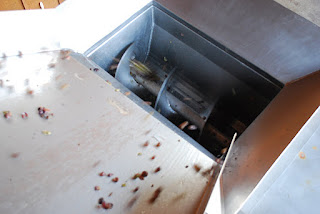
After lunch today, it was time for more crush. We sort and de-stem Abby's Block first. Then we move on to the Syrah (which the crew also harvested), and then we take care of some Pinot Noir that came from another vineyard. After the sorting table the grape clusters go down the shoot that you can see in the photo to the right. The auger sends them along into the de-stemming device. One guy stands on a ladder all day and picks up leaves and stems that make it through both the sorting and de-stemming. I just can't imagine doing that. And remember, these guys are doing this work after they have done another job. It's really two days work all in one.
In the photo to the left you can see the two rollers that only allow the grapes to fall through. The device that does the de-stemming is a rod with finger like protrusions which are in a kind of spiral staircase configuration. They guide the grapes through a round tube that has square holes in it, which are about the same size as the grapes. When all of the grapes have been processed and put away the clean up begins. I've found it's best to just get out of the way and let the crew work. The primary tool for cleaning is the Lamba steam cleaner. I don't know how you'd run a winery without such a machine. It is powerful. Unlike your home pressure washers, it runs on 220 power. And that's just for the water pressure. The water is also heated by a diesel powered burner. I was using it the other day to clean off the top of the wine press, and when I pulled the trigger it almost blew me off the ladder.
In the photo to the right, Berto is standing on top of the destemmer pulling it apart so that it can be cleaned. Everything is steam cleaned. The inside parts, the outside surfaces, and the concrete floor under the equipment.
Well, it's late and I'm starting to fade. Scott showed me a schedule tonight, and it turns out we may actually finish this work in the not too distant future. I'm glad now that I got my sabbatical extended to Thanksgiving weekend. Who knew we would have just barely finished up crush by then?

Punch Down at CdT

I was up at the crack of dawn this morning. When the sun started to stream into the valley I was already up at Couer de Terre watching the last of the fog roll away.
I have a new ritual when I arrive at the winery. It's called punch down. To do a punch down you grab one of the plunger looking devices that is attached to a four foot long handle. Once the yeast has been added to the grapes and fermentation is going a crust starts to form on the top of the bin. You have to take the plunger and push it through the crust and down to the bottom of the bin. Sounds easy, doesn't it? The cake-like crust can be almost a foot thick and practically impossible to push down. And remember, this is where winemakers die. The juice is giving off CO2 as it ferments, and if you inhale enough of that you go face first into the bin. Scott has now reminded me several times to be careful, especially when we have dozens of fermenters all going at the same time.
Next up is taking the juice's temperature. Mostly Scott tells me we're looking to see if the fermentation takes off out of control, and a very high temperature would be an indication of that. Once the yeast are introduced the mix gets hot. You can feel the heat when you stand next to the bins in the morning. You can also smell them. It's starting to smell like wine, with that beautiful, yeasty, musty aroma that I love. You take the temperature of the juice with a three foot long metal thermometer. The juice that the thermometer is in in the photo to the right has not started fermenting yet. It's been in a cold soak for about three days. Today we brought it up to temperature, and then added the yeast. Tomorrow the temperature will be up in the 80's.
The next step in punch down is to check the specific gravity. I asked Scott what this is. The hydrometer is calibrated to read zero in water. Anything with more sugar that water will give you a more buoyant reading. The wine will
actually have a negative specific gravity once it has produced alcohol. To get the juice sample you take a strainer and push it down into the crust until it begins to fill with juice. Then you dip a cup into the strainer to grab some of the juice. The liquid is poured into a tall tube and the hydrometer is placed into the liquid and swirled.
Before fermentation has begun the numbers are larger. In the photo below you can see that the specific gravity is reading 22. As fermentation gets going that number will be cut in half in as little as 24 hours. It's amazing how quickly fermentation takes off, and how dramatically the juice changes taste, smell and texture and color as the process goes forward.
The final step is punch down is, of course, cleaning up. You grab a rag, spray some alcohol on it and clean the inside of the bin. Once that's all done, and the data for each bin has been recorded, you cover up the bin again. Punch down has to be done every eight hours. Scott's doing it late tonight, I'll be there to do it first thing tomorrow morning.
We are headed for some long days. We have two vineyards sending us fruit tomorrow, and Scott is going to have his own crew harvest the last of the estate Pinot Noir. We also have to get three more fermenters up to temperature and add yeast to them. I got the the winery a little after 7:00 this morning and left around 9:00. Tomorrow should be later.
A wine guy stopped in today to talk. He wanted to know if I was the winemaker. Good lord. I couldn't look more like a custodian if I went to the theater and had them costume me. I'm wearing my construction orange rubber overalls with work boots, and a tattered, old, stained grey tee shirt. I'm also knee deep in dirty hoses that I'm steam cleaning. Really? Is this what a winemaker would look like? And then it occurs to me. Yes, this is what winemakers do most of the time. The idea of making wine is so romantic. The reality of making wine is constantly cleaning and just a whole lot of very hard work. This experience is going to make me much more thankful for the wine that I drink, for the hands that have planted the vines, for the hands that have pruned the vines and trained them up the trellises. I'll be thankful for the hard working people who harvested the grapes, and those that did the crush. I'll be thankful for those who did the punch downs and actually made the wine.
I did sneak outside around 5:00 tonight, and the sun was starting to set and the moon was rising. Just another beautiful moment in the Couer de Terre Vineyard. It was nice to see the sun!