Thursday, September 29, 2011

The Great 2011 Fruit Drop

Even now it kind of takes my breath away when I see it. I was walking through Coeur de Terre Vineyard and they had just dropped fruit. What does that mean? In a late fruit set year like this one at the end of the growing season the vineyard manager will go through and have the crews cut off up to half of the fruit. In some rows it looks as though there is more fruit on the ground that there is on the vine. Why would they do this? Why would you go through a vineyard and cut off perfectly healthy fruit?
There are two reasons. One is the give the remaining fruit a better chance of actually getting ripe. With a large section of the fruit gone, the vine will give more energy to the remaining fruit, giving it a better chance of getting ripe. It is going to be a very late harvest this year--around October 26th for Pinot Noir, and maybe November for Riesling. It's going to be a nail-biter at the end of October to see whether the rainy season holds off just long enough for the fruit to ripen.
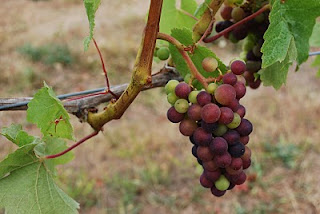
At Coeur de Terre they have cut the fruit back to one cluster per shoot. Many vineyards use two clusters per shoot, and some leave two clusters on one shoot, and only one on the next. This year is the most austere I have ever seen. Can you imagine what it must feel like to nurture these plants, to care for them and prune them, to feed them and hope they grow--and then go and throw half of them on the ground? I'm not sure I could do it. You can see how beautiful some of the fruit is at the photo to the right (complete with yellow jacket!) The second reason to drop fruit is to increase the complexity and depth of the fruit.

Today I was out with Scott Neil, the owner of Coeur de Terre to look at some of the fruit he is purchasing from other vineyards in the McMinnville AVA. It turns out there are quite a few that I'd never heard of--vineyards that do not make their own wines, but sell to other wine makers. We are checking out a few sights from which Scott is sourcing some of his fruit this year. The first we visit is having some problems. Some of the vineyard was planted with self rooted vines, and they have phylloxera in the vineyard. These vines are being torn out and are being replaced. They also have a section which has a virus called leaf roll. I'd never heard of it before. It's systemic, and the vines which have it will need to be pulled out, and the land left fallow for up to five years before it can be planted again. Since it takes five years for a plant to mature enough to produce fruit, it could be up to a decade before those areas will produce fruit again. It takes a special person to own and manage a vineyard. Someone who can make very difficult decisions about how to allocate resources. I often hear people say how wonderful it would be to live on a vineyard, or to own one. I'm not so sure.
I will be starting my internship with Scott in just a few weeks (or whenever the grapes to finally get ripe.) I'm excited to get to experience crush, and see how wine is actually made. It will make me appreciate all that much more the beautiful wines we are able to enjoy here in Oregon. Wine is an amazing symbol of God's grace to humanity, of how much God loves us. That grace, however, does not come cheap. It requires an incredible amount of hard work and dedication. I think I'll have a much more concrete picture of that work about a month from now.

Friday, September 16, 2011

Pinot on Chardonnay at Witness Tree Vineyard

There are several vineyards that I want to study while I'm on Sabbatical. Each has a unique quality that has caught my attention, and caused me to want to learn more about them. One of those is Witness Tree Vineyards which is just east of Amity. It was named after the huge oak tree which dominates the hillside about half way up the vineyard and is used as a surveying point. I wanted to do some preliminary research on a wine they have provocatively called "Chainsaw Red". I just love a winery that celebrates a form of cultivation on a wine label. I want to get a look at the vines that produce this wine. Specifically I want to look at the mature Chardonnay vines that were lopped off with a chainsaw so that Pinot Noir vines could be grafted onto them. There are two things about this process that fascinate me. First of all that you can do that. Just top off a mature vine and graft a different varietal onto it. And, secondly, I'm amazed at how vineyard managers make decisions like that. "OK, lets bring in the chainsaws, wipe out these vines and do something completely different." As someone who works in a church this kind of decisive leadership is impressive.
So I dropped by anonymously early on a Thursday to do some research before I bother the vineyard manager. I've already contacted Steven Westry by email, and he graciously told me to call him directly, but I want to know a bit more before I deal directly with him. I love this winery. There is something magical about the wines that come from this part of the Eola-Amity Hills AVA (American Viticulture Area). To me there is also something understated about the tasting room at Witness Tree. It's friendly and welcoming, and unlike some other wineries in the area they have some wines that are within my price point. Chainsaw Red Pinot Noir is one of those wines. So, I introduce myself to the young woman who is behind the bar, give her one of
my cards and ask a few questions. She puts up both hands and says immediately, "I'll get Steve."
Before I can object Steven Westry is standing in front of me. He's just returned from a sales trip somewhere down south and he's tired. He is also one of the most gracious and welcoming wine makers I have every met. I ask about the chainsaw vines. I had thought that they were American root stock, grafted with Chardonnay, and then re-grafted with Pinot Noir. It turns out that a lot of this vineyard was planted with self rooted vines. That is a problem. There is a little root louse called phylloxera that kills European root systems like Chardonnay and Pinot Noir. I know that another vineyard just up the hill has the problem, and, it turns out, so does Witness Tree. I can't imagine the pain of seeing large swaths of your vineyard go from green, well producing vines, to practically dead, non producing ones.
Steven takes me out and shows me one of the Chainsaw vines. You can see it in the photo above. The two shoots at the top of the vine are the new varietal which was introduced after the old was topped off. I learn some really interesting things right away. The most amazing to me is
that the Pinot Noir on Chardonnay root stocks produce larger clusters of fruit than the the ones
that are self rooted. (That's a cluster of these grapes in the photo to the right.) Chardonnay roots just send more energy, water and vitality to the grapes. That blows me away. I ask Steven why they did this. It turns out that when the original owner of the property went to get a loan to plant a vineyard (of all things) the wise bank officials insisted that they had to have "bankable" varietals on the property, if they wanted to mess around with this unproven Pinot Noir, that was fine, but half the vines had to be Chardonnay. So, as over time Pinot Noir became "THE" grape, the vineyard found itself with much more Chardonnay that they could effectively market. So, out came the chainsaws. It was a specialty company from California that did the work. Steven explained that this was a stop gap measure. It's not the best way to grow Pinot Noir, but when you pull out the old vines and plant new it takes seven years for the new vines to produce usable grapes. With this method they were producing a full crop the next year. Steven explained that these vines are at the bottom of the property in the "Missoula Floods" soils. These are not the soils that grow great wines. Those soils are up at the top of the property. I ask about those, and Steve asks if I want to go up on a tour. Oh hell yes. So we drive over to one of shop buildings, grab a "Gator" and are off.
I can't believe I'm getting to do this. Two things about these upper vines just jump out at me. First of all the clusters are much smaller. (That's one to the left.) Secondly, at just a few hundred feet of elevation gain the grapes have about half as much color as the ones down the hill. The best wines are made from these upper vines. The ones on the Chardonnay roots at the bottom of the hill in the alluvial soil make perfectly acceptable wine. But these vines that have to struggle, that will barely become ripe by winter, that have so little fruit per shoot, these will produce the complex, many layered wines that will set you back $60 and more.
Steven has been away from the vines for a bit. He is closely examining each section. They have tried various ways of dealing with the problem of original root stocks. There are several four acre sections that have been torn out for a new start. There are sections where they have planted new vines on American root stock in between the self rooted vines.
As we head up the hill I'm amazed at how different the soils are. Some are the red "Jory" type of soils. A bit higher the soil is filled with rocks and is more brownish. Each brings a different note of flavor to the wines of the estate.
I didn't get a chance to do a tasting, but I will be back. Steven is a gifted wine maker and I feel so blessed to have been able to get a tour and ask an endless series of questions. I want to come back and get a few of those upper level wines and lay them down in my cellar for a few years, then bring them up to celebrate some important event, or to give to someone I love. They will taste even better knowing the story behind them and the person who tends the vines and makes the wine.

Monday, September 12, 2011

Left Coast Cellars Revisted

Time is an amazing gift. How many times have you driven by some place and said, "I should stop there." Robin and I have been feeling that way about Left Coast Cellars for quite a while. We visited there seven years ago, and the winery had just opened for business. Several times as we've driven by Robin has said, "we should stop in there." And one of the great gifts of my sabbatical leave is that now we do have the time.
There was so much we liked about the winery the first time we were there. The setting is so beautiful with the tasting room nestled into the top of the vineyard in the midst of a beautiful grove of oak trees. The landscaping is so well done and the drive up to the tasting room is sweeping and gorgeous. We love their logo and the idea of celebrating the West coast of the United States as the left coast. We loved everything, but we didn't really like the wines. Things have changed.
I especially loved their estate grown Pinot Noir called "Cali's Cuvee" which is only $24 a bottle, and I didn't taste a single wine I didn't enjoy enthusiastically. There are many there are several possibilities for the changes. Maybe it's just me--maybe my taste buds have matured and been enlightened a bit in the last seven years. Maybe I was having a bad day the first time around. Perhaps the vines are just producing better fruit now. Maybe the winemaker has figured out how to best coax a beautiful wine from the grapes in that place. There are a million different reasons, but the result is the same, this time around I loved their wines.
We were able to sit outside on the patio, and our server, Amy, graciously offered to bring us out our tastings. There is now a cafe inside the tasting room, so we ordered lunch, and it was beautiful. I had a club panini and Robin had a salad made from locally grown greens. This may become our new favorite place--just head out, sit in the beautiful tasting area, have a quick bite to eat and enjoy a beautiful wine. The tasting fee is only $5 and is waived if you purchase a bottle of wine.
There are beehives surrounding the tasting room and they sell that honey inside (you can't get much more local than that.) They have a Chardonnay that has seen a little bit of oak (for those of you who like that.) It's from the Truffle Hill section of the vineyard which is named after the experimental efforts to propagate the expensive fungus among the roots of nearby hazelnut trees.
There is a hard to describe vibe to Left Coast Cellars. Serving wonderful food in a beautiful location while trying to import some crops to along with them. They have a Pinot Noir that is in a keg which they will sell by the bottle, which you then return to have refilled! I have been looking for this for quite a while, a refillable wine bottle (I take a lot of bottles to the recycling center each month, and I'd love to be able to have one that I could just refill and use again and again. They are using magnum bottles (holds two regular bottles of wine). I wish they would just use growlers like they do at brew pubs.
The winery is also sustainable and green. They have solar panels which are supplying most of their electricity, they drive efficient vehicles and have a gravity fed natural spring irrigation pond on the property. I would recommend taking an out of town friend to Left Coast for lunch. It's exactly the kind of Oregon wine experience I love to share with people. I'm thankful for the time to be able to stop in and enjoy the beautify of the place of the wines they are producing. It was also heartening to see how much color the grapes have added in just one week of warm weather. We may see a grape harvest before Halloween after all!

Sunday, September 4, 2011

Walking Tour of Sokol Blosser Vineyard

I'm on an extended leave from my church job. It's called a sabbatical. While I'm away I am studying vineyards and winemakers to see what lessons we in the church might learn from these exciting and creative people. Last Saturday I went on a walking tour of Sokol Blosser winery. The winery offers the tours throughout the summer months. Several caches of wine are hidden throughout the vineyard and the group walks up and down, tasting wine and learning about viticulture and wine making.
The tour included a quick stop at Red Ridge Farms to learn how they grow olives and press them into oil. They don't quite have enough Oregon olives to meet their needs, but are getting closer every year. I am so excited to have a local olive oil. Then I can make m own pesto with all local ingredients (I substitute hazel nuts for pine nuts). I really enjoyed this tour. It was informative, good exercise and fun. Our tour host was Jeff Knapp, the Hospitality Manager at the vineyard. He is animated and refreshingly honest. His knowledge of wine was deep, and he was able to communicate his complex knowledge in a down to earth and easy to understand fashion. Jeff grew up in the mid-west and decided at some point that he wanted to live in a place where they cherished food. Portland seemed a natural choice.
The first leg of the tour is down the hill and around the Concert Block at the very bottom of the vineyard. Jeff explains to us that the soil at the bottom of the vineyard is called Woodburn. It is the beautiful, sandy loam soil that was delivered to the Willamette Valley by the Missoula floods. It is a brownish color. Jeff points out that as we climb the hill the color of the soil
will turn to the classic red of the Dundee Hills. This is Jory soil and is ideal for growing Pinot Noir. At Sokol Blosser they use the lower quality grapes at the bottom of the hill to make a Pinot Noir Rose. They make a Rose from red grapes by leaving the juice in contact with the skins for a short period of time. The color of the wine comes from being in contact with the skins of the grapes. The pulp inside the skins has no color.
As we climb we see that some of the grapes in some of the clusters are starting to turn color. This is called veraison, and this is late as anyone I have talked to has seen it take place.
As we walk up the western edge of the Concert Block we are instructed to stay close to the vines on the Sokol Blosser vineyard. Just across the way are some of the first Pinot Noir vines planted in the Willamette Valley. We are looking at the ancient vines that make up Erie Vineyards. They are self rooted and therefore vulnerable to a root louse called phylloxera. It is deadly to roots of European vines like Pinot Noir. Sokol Blosser originally planted self rooted vines and suffered an
outbreak of the disease. These ancient vines (in the photo at the left--taken with a telephoto lens) are vulnerable and we could track it over on our feet, so we stay well away. At
the top of the Concert Block Jeff has a stash of wine glasses and a bottle of their Pinot blanc.
Last summer I had the privileged of meeting Susan Sokol Blosser and listen to her talk about the very beginnings of the wine industry in the Willamette Valley. Their winery went through a difficult transition from conventional farming to an organic approach. I've always wondered how they managed to make it. In the book Sokol Blosser talks about some of the difficulties they faced with blight and fungus, how it looked like they would loose entire sections of the vineyard. It turns out that when they made the transition they tried the bio-dynamic
approach. Organic farmers are allowed to use a number of sprays to treat their plants. Now the vineyard focuses on organic, sustainable farming methods that keep streams and rivers safe for fish and wildlife.
We see several other features of Sokol Blosser's care for the environment as we tour the vineyard. They have a grey water treatment field where wash water from sinks is used to irrigate a field. The water nourishes plants on the surface and then is filtered and makes its way back down into the water table to be used again. Sokol Blosser built the first building to be used as a wine tasting facility, and the first building to be used as a wine making facility. We also get to tour their barrel aging cellar. It is a concrete barrel vault construction which is buried in the ground. The very top has three feet of earth on it with native plants and grasses growing there. The building was the first wine facility in the state to be LEED certified for energy efficiency. It is a cavernous, damp space with wine barrels stacked to the ceiling on either side of the center aisle. Jeff explains that they can draw air through ducts that are buried deep in the hillside if they need to cool the cellar in the middle of the summer. The space also has an automatic humidifier with overhead sprinklers that come on if things get too dry.
We end the tour with a luncheon spread out for us on picnic tables just outside of the tasting room. It is a beautiful spread and the group of folks in the tour enjoy various conversations. The one at the far side is around ballet and dance, and the one at our side centers around teaching. I get a chance to ask Jeff his opinion of the '07 vintage which was so criticized when it came out. "It is one of my favorite vintages" he states. "We are raising the price from $40 to $50 dollars a bottle." We get to taste the '08 and the '07 and I have to agree that the earlier vintage is beautifully complex and more lively in aroma. This vineyard tour is a lot of fun and the $40 cost includes lunch. If you have some friends in town next summer who enjoy wine and are able to hike up and down a vineyard this tour would be a great Oregon Wine experience to share wit them.